Motovun Day Trip from Rovinj: Truffles and the Hilltop Town
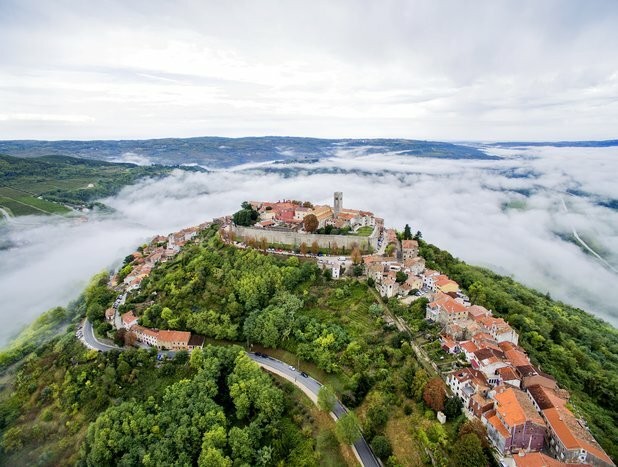
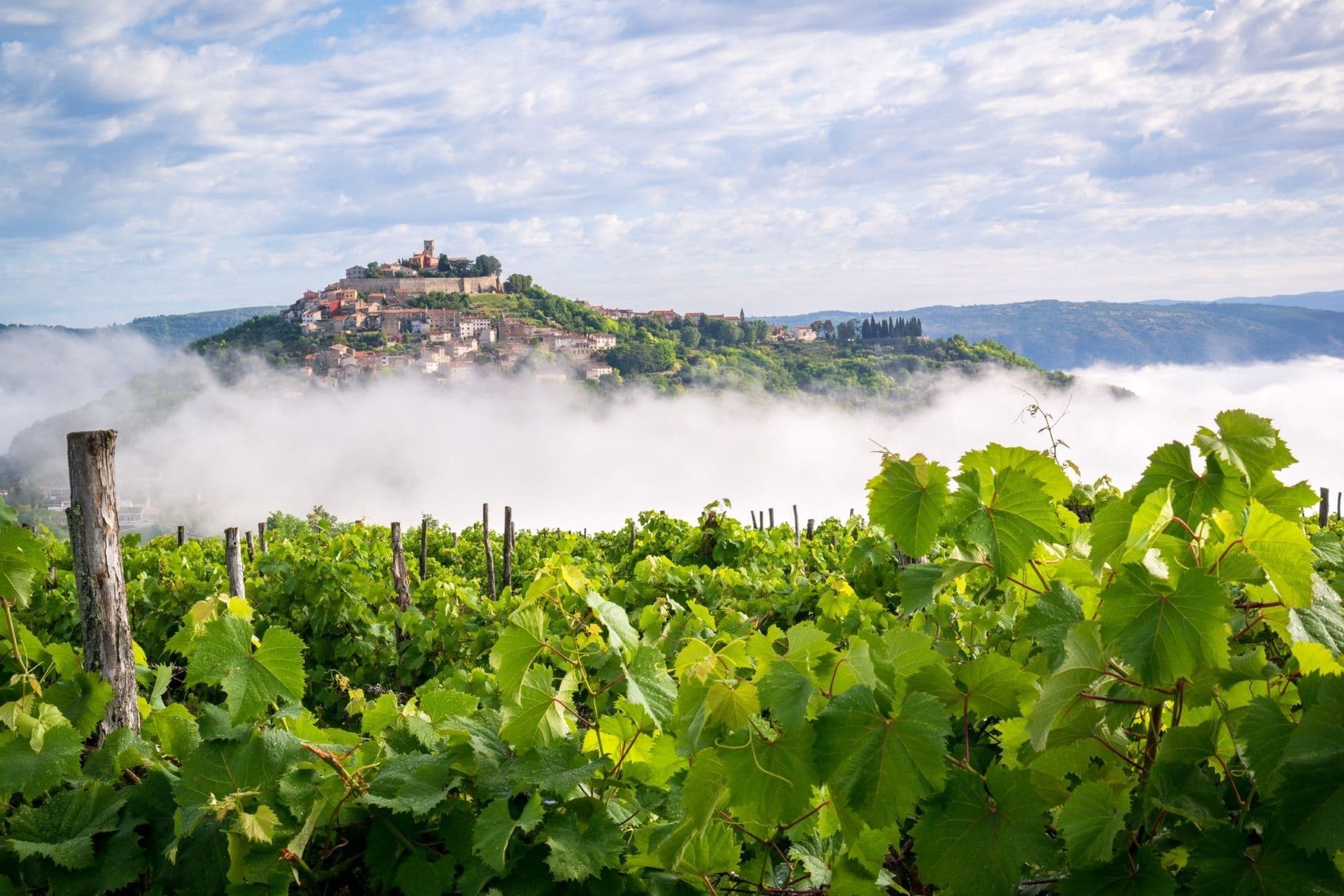
Motovun is a walled town of about four hundred people on a hill 277 metres above the Mirna valley, an hour inland from Rovinj. On the right autumn morning the valley below fills with fog and the town appears to be floating on it. That photograph is the reason most people come, and it is worth planning the day around.
The other reason is truffles. The forest directly below the town is one of the best white truffle grounds in Europe, and the town above it has built a small industry on that fact. Both things are real. Neither is the whole day, and knowing what else is up there is what separates a good visit from an hour of photographs and a coffee.
The town, and the walk up to it
Motovun came under Venetian rule in 1278 and the double ring of walls that still encircles the town is the best preserved in Istria. You can walk the full circuit of the ramparts, and that walk is the single best thing here: the view runs the length of the Mirna valley in one direction and over the forest in the other. Note that the wall circuit is ticketed — €5 for adults in 2026 — and closed from December to mid-March.
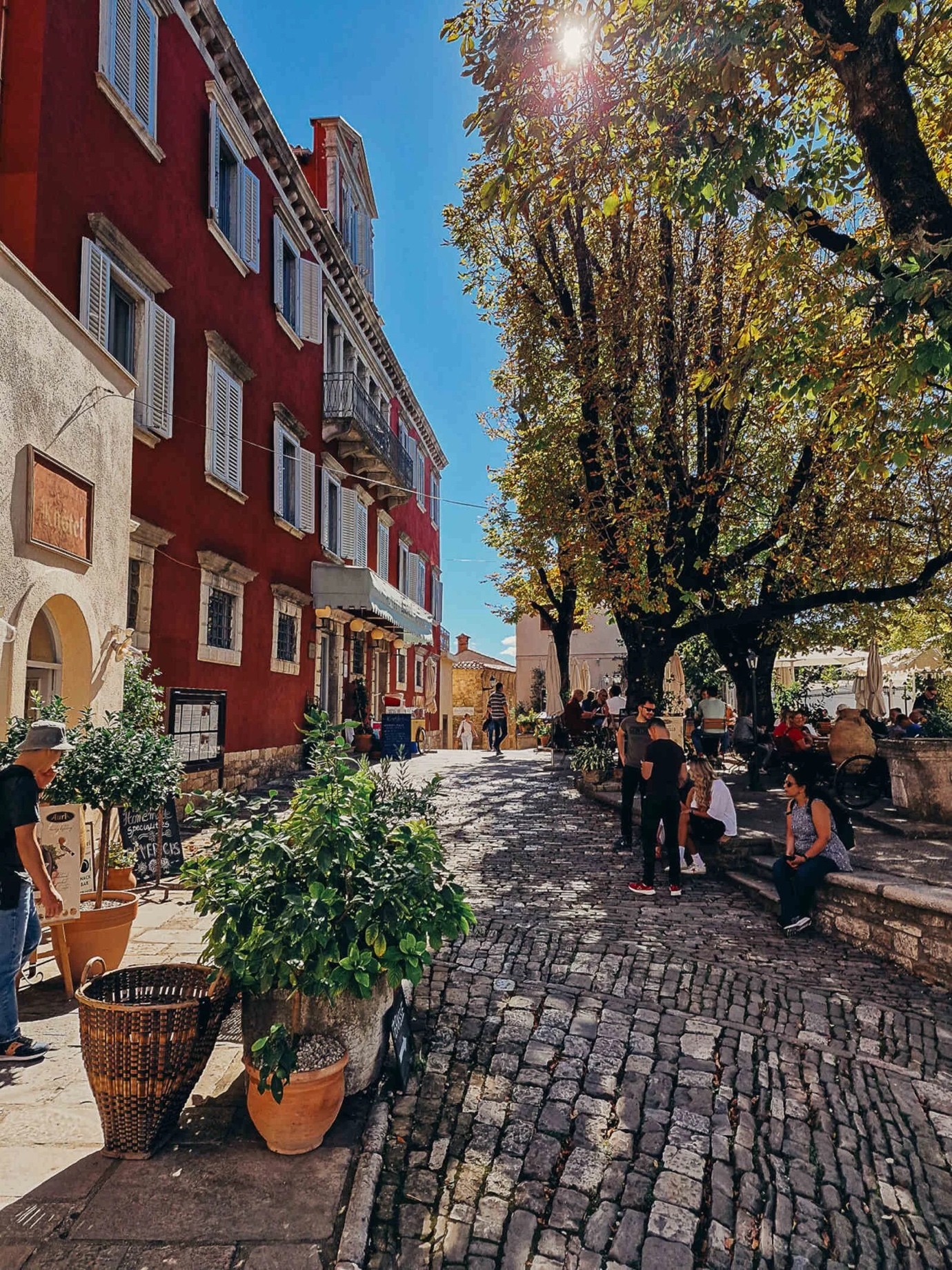
Be clear about the approach before you go. The walled town keeps cars out. You park below and walk up, roughly twenty minutes on stone and cobble, and the climb is the part people underestimate on a hot afternoon in July. It is hard work with a pushchair or with anyone unsteady on their feet. There is a shuttle from the lower car park, but it is not free and it leaves when it is full rather than to a timetable.
Truffles: what is actually in season
Most sites say Motovun is famous for truffles and stop there. The seasons matter, because they decide what you will be eating and what you will be paying.
- White truffle — late September to January, peaking in October and November. This is the expensive one, shaved raw over pasta or eggs, and it is what the autumn crowds come for.
- Black winter truffle — roughly October to March. Cheaper, stronger, better cooked than raw.
- Summer black truffle — harvested through most of the year. This is what is in the jars, the oils and the cheeses you will see in every shop, and what you are most likely eating if you visit in June.
In 1999 Giancarlo Zigante and his dog found a white truffle weighing 1.31 kilograms near Motovun. It went into the Guinness Book of Records as the largest ever found, and it is the reason the name Zigante is on half the shopfronts in the valley.
Two autumn events are worth timing a visit around. Zigante Truffle Days runs through October in Livade, at the foot of the hill, with hunts, tastings and cooking demonstrations. And Subotina in nearby Buzet, on the first Saturday of September, opens the season with a truffle omelette made in the town square from two thousand eggs.
If you want to see the truffle side of Motovun properly rather than buying a jar in a shop, arrange a hunt with one of the local families in the forest below the town: you follow the dogs into the oaks for an hour or two, and they find things. It needs booking ahead, and it is the part of the day people talk about afterwards.
How long to allow
Motovun itself is small. The walls, the church, the main street and a coffee take about two hours, and you will have seen it.
The reason to allow longer is lunch. A proper truffle lunch in or below the town runs to two hours and is the point of the trip for most people, which makes it a five to six hour day from Rovinj including the drive. Add a truffle hunt and it becomes a full day.
If you are short of time, go for the late afternoon instead: arrive around four, walk the walls in better light, eat early and drive back. The town empties after the coach parties leave and it is a different place.
When to go
October and November are the best months, and it is not close. White truffle is in season, the vines below are turning, and the valley fog that makes the famous photograph is an autumn and early-winter phenomenon — it forms overnight and usually burns off by mid-morning, so you need to be there early to see it.
Late July and early August bring the Motovun Film Festival, running since 1999, which fills the town with several thousand people and screenings in the squares. It is a good time to be there if that is what you want and a poor one if it is not.
Midsummer outside the festival is hot, exposed and busy with day-trippers between eleven and four. Spring is quiet and green, with no white truffle.
Getting there from Rovinj
There is no realistic bus. Motovun is inland, the connections run through Pazin or Buzet, and nothing lines up for a day trip — this is the single most common reason people give up on the idea.
Driving takes about an hour on good roads, and the last stretch is a narrow climb with parking below the walls that fills by late morning in season. If you intend to have the truffle lunch and the wine that goes with it, someone has to stay sober.
That is the case for a private transfer from Rovinj to Motovun. We drop you at the gate, wait, and take you back — which for a town built around long lunches and local wine is the part that matters.
Practical notes
- Park below and walk up. The climb is steep, stone-paved and slippery in the wet.
- For the fog photograph you need to be there at or before sunrise in autumn. By ten it has usually gone.
- Book a table for a truffle lunch in October and November. The good places fill up.
- Truffle hunts must be arranged in advance — they are not something you can join on the day.
- Opening hours shorten considerably from November through March, and some places close entirely.
Travel time from Rovinj: about one hour each way.
Plan your transfer
Hum and Pazin Day Trip from Rovinj
Hum has fifty-two residents. Pazin, half an hour away, has around four thousand and is the administrative capital of Istria. Between them sits a gorge that swallows a river, a castle that gave Jules Verne a novel, and seven kilometres of road lined with stone monuments to an alphabet almost nobody can read any more.
This is the inland Istria that the coastal resorts do not advertise, and it is an hour from Rovinj.
Hum, the smallest town in the world
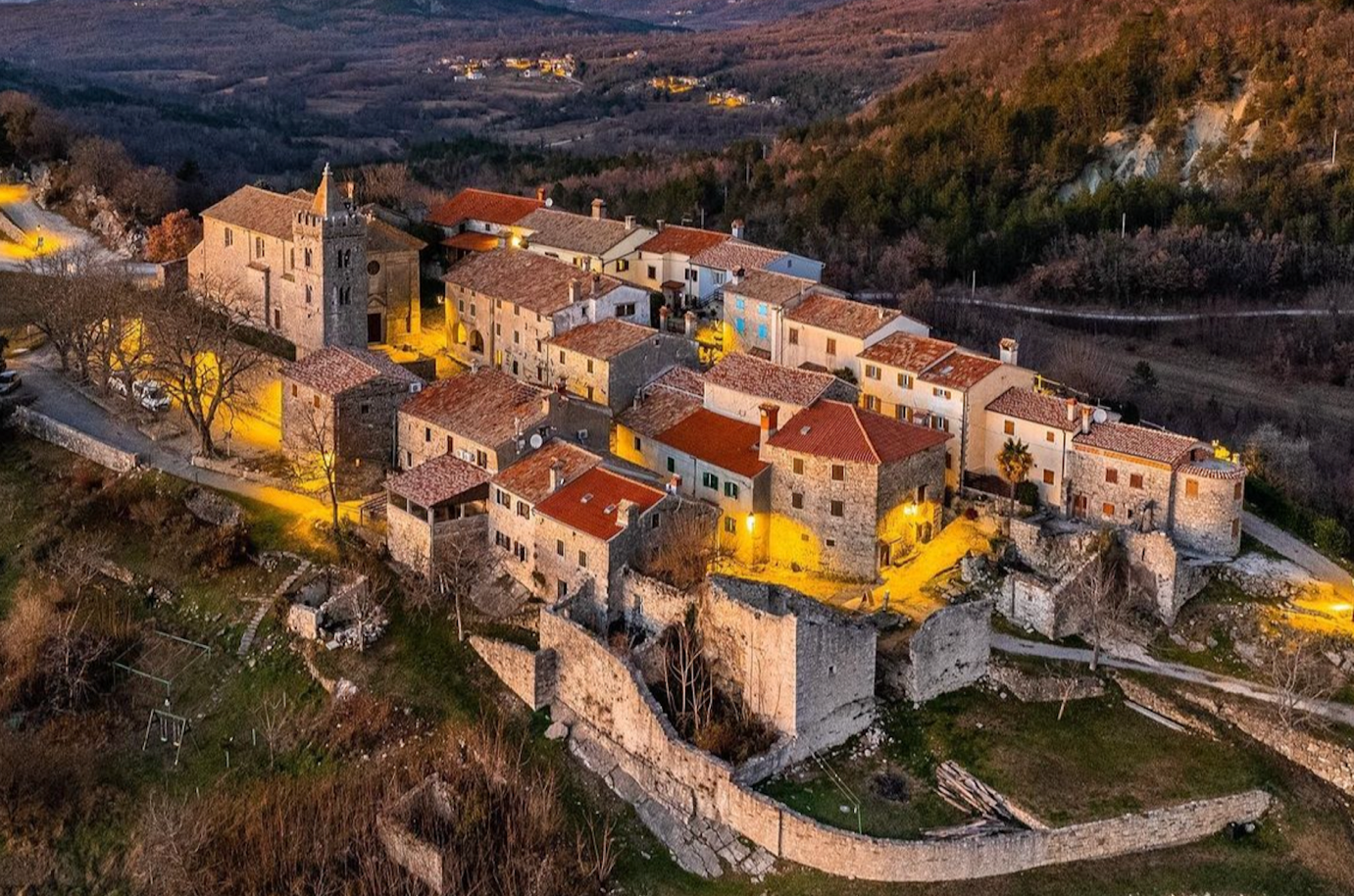
Hum calls itself the smallest town in the world — a title held by tradition rather than any official record, since Guinness has no such category. Fifty-two people live in the wider settlement, around twenty to thirty of them inside the walls. It sits at 349 metres and was first written down in 1102, as Hulm. Two streets, one gate, a bell tower of 1552. Walking the whole place takes about fifteen minutes, and that is the point rather than a complaint.
The road in is the real attraction. The Glagolitic Alley runs the seven kilometres between Roč and Hum: eleven monuments, ten in stone and one in copper, placed between 1977 and 1985 to mark the history of the Glagolitic alphabet. The eleventh is the copper gate of Hum itself, so the Alley ends at the door you walk through. Hum also makes biska, a mistletoe brandy, sold in the konoba by the gate.
Pazin, the castle and the hole in the ground
Pazin is a working town of about four thousand people in the middle of Istria, and it is the county’s administrative seat. Nobody goes there for the shopping. They go for what is underneath it.
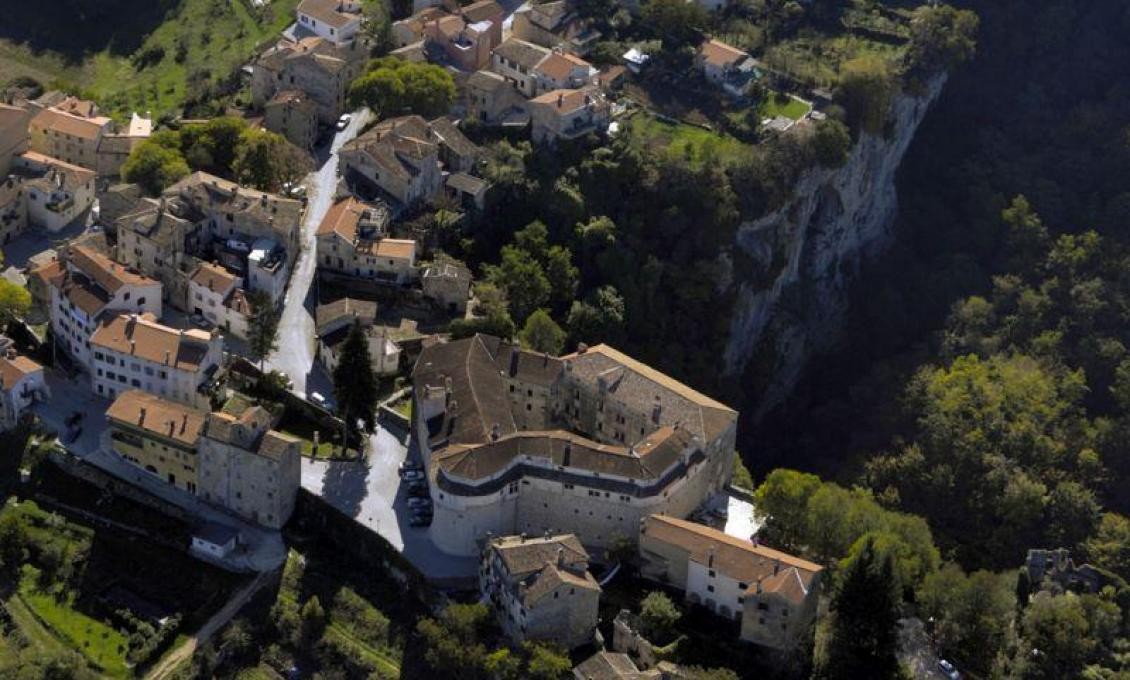
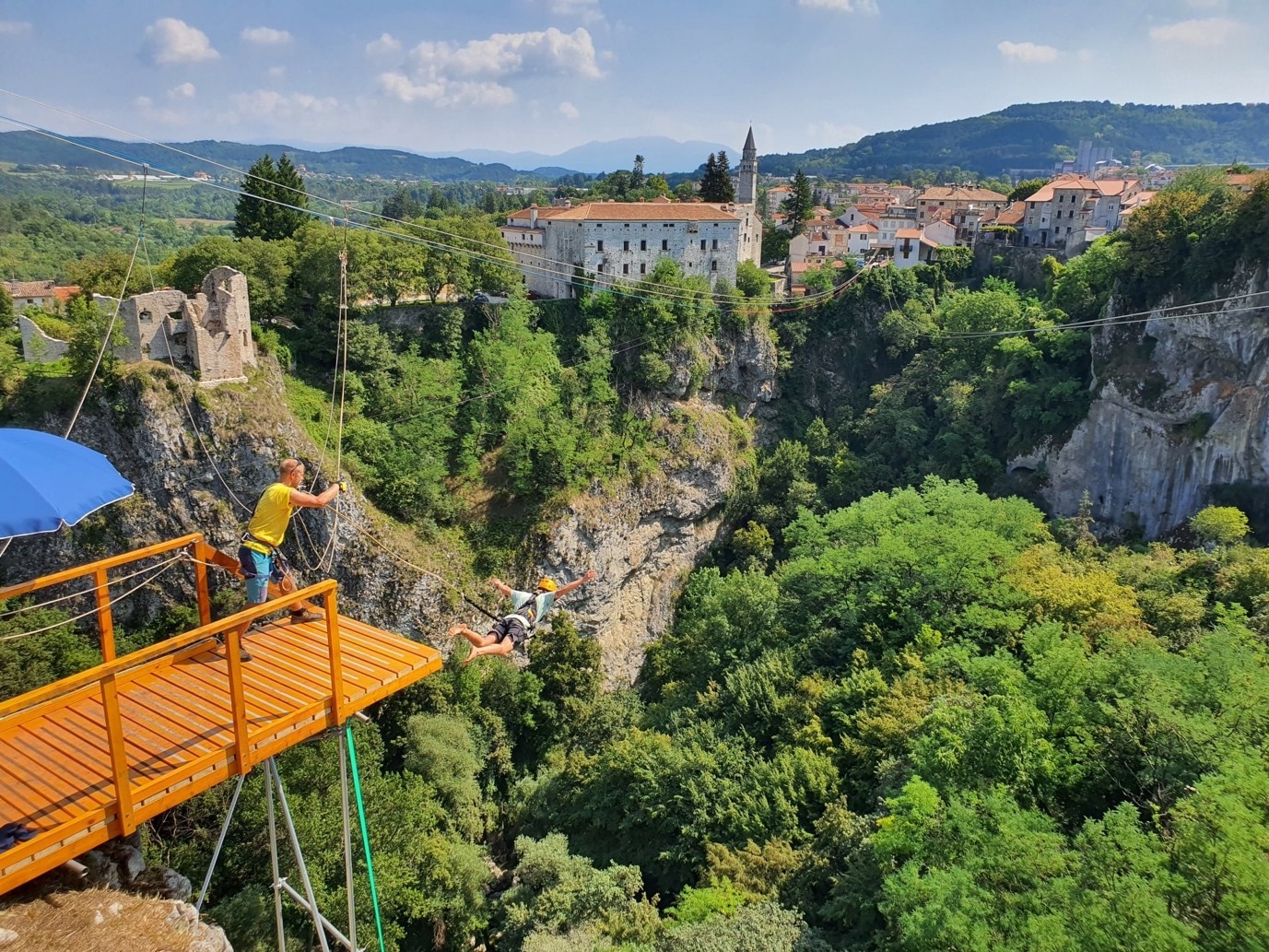
The Pazin abyss — Pazinska jama — is a ponor: the point where a river reaches a cliff and disappears into the karst instead of carrying on along the surface. The gorge falls roughly a hundred metres and the castle sits directly on its edge. It was first explored in 1893 by the French speleologist Édouard-Alfred Martel, and it is still the best example of karst hydrography anywhere in Istria. The gorge and the castle together gave Jules Verne the setting for Mathias Sandorf in 1885 — a book he wrote without ever visiting.
Pazin Castle holds the Ethnographic Museum of Istria and the Pazin Town Museum, both on one ticket. There is also a zipline strung across the gorge and a guided caving tour that goes down into it; both need booking, and both are seasonal.
How long to allow
Hum takes half an hour to see and an hour if you eat. Pazin takes two: the castle and museum, the viewpoint over the gorge, and the walk down into it if it is open. The Glagolitic Alley adds twenty minutes of stopping on the way between them.
Together with the driving that is a five to six hour day from Rovinj, and it is the least crowded day trip in Istria by some distance. If you have already done Motovun and want the interior without the coach parties, this is the one.
When to go
Spring and autumn. The interior is green, the temperature is bearable and everything is open. Hum in particular is a different place in May than in August — the stone holds heat and there is very little shade.
Hum elects its town prefect once a year in an old ceremony that draws a crowd far larger than the town; if you want to see it, ask locally for the date before planning around it, as it moves.
In winter a number of places in Hum close and the zipline does not run. The castle museum keeps shorter hours from November.
Getting there from Rovinj
There is no sensible bus to either. Pazin is on the rail line that crosses Istria, but the service is sparse and the station is a walk from the castle; Hum has effectively nothing.
By car it is roughly an hour to Pazin and a little more to Hum, on roads that are good but winding for the last stretch. The two sit about twenty-five minutes apart.
This is a trip where a driver earns their money: the interior roads are quiet but unfamiliar, the signage is thin, and the distances between the things worth stopping at are exactly the sort that make a self-drive day feel longer than it is. We run it as a private day trip from Rovinj with the stops built in.
What to eat
Inland Istria eats heavier than the coast and better in cold weather. Look for maneštra, a thick bean and vegetable soup that is the regional staple, and ombolo — pork loin, usually with sauerkraut or potatoes. Game appears on menus through autumn and winter.
Hum has one konoba by the gate and it is small. If you want lunch there rather than in Pazin, it is worth calling ahead, particularly out of season.
Practical notes
- Hum is car-free inside the walls, though the walk from the parking is short and flat by Istrian standards.
- The viewpoints over the Pazin abyss have railings but the drop is a hundred metres. Keep hold of children.
- The zipline is seasonal, weather-dependent and must be booked. Do not build the day around it without confirming.
- Castle and museum hours shorten sharply out of season.
- Both towns are cash-friendly rather than card-first. Carry some.
Travel time from Rovinj: about 1 hour to Pazin, about 1 hour 20 to Hum.
Plan your transfer
Grožnjan and Poreč Day Trip from Rovinj
Grožnjan has 142 permanent residents and roughly twenty art galleries. Poreč, forty minutes down the hill, has a sixth-century basilica on the UNESCO list and enough hotel beds to house a small city in August. Putting the two in one day gives you the two extremes of Istria between breakfast and dinner, and the order matters: hill town first while it is cool and empty, coast afterwards.
Grožnjan, the town that was saved by artists
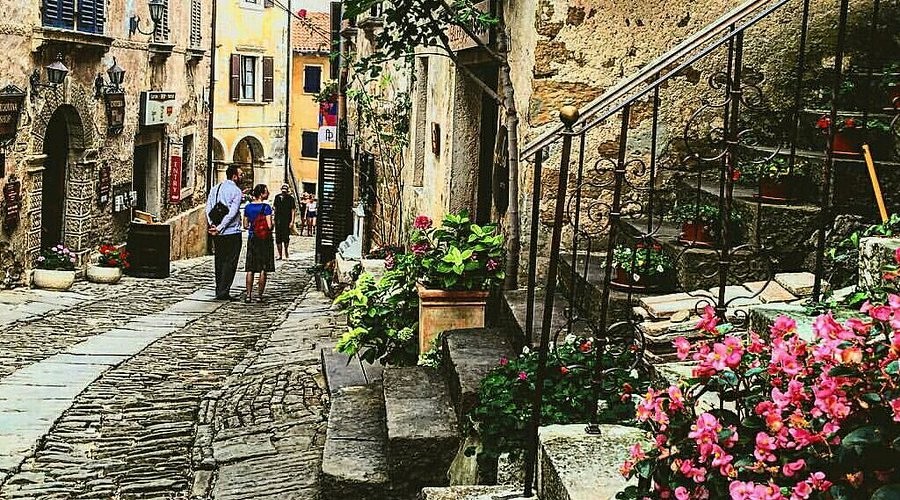
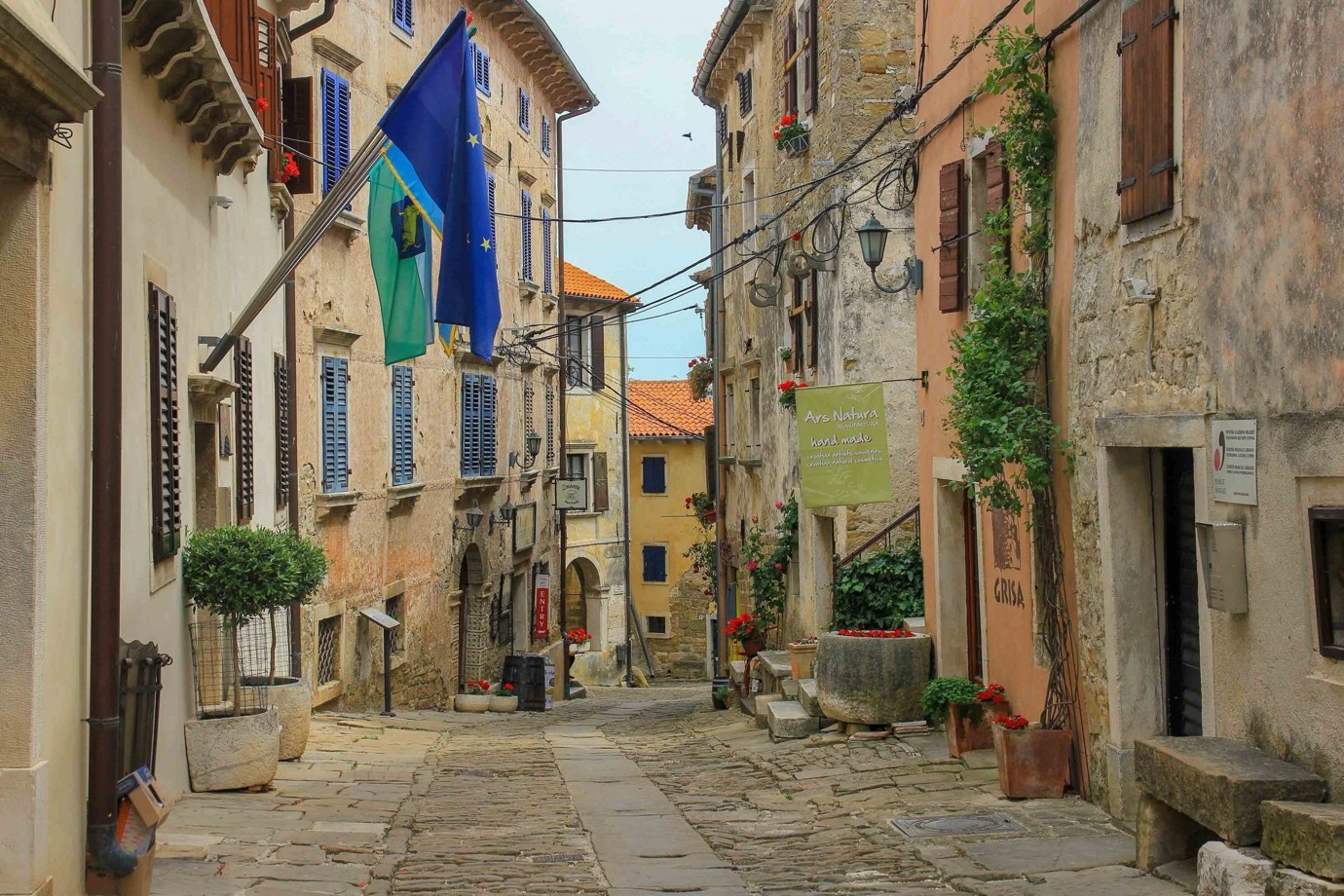
Grožnjan emptied after the war — a municipality of just over 4,000 people in 1910 lost around two-thirds of its population by 1956, and the houses stood open. In 1965 they were given to artists on the condition that they restore them, and it worked. The town today has twenty to thirty galleries and studios in a handful of lanes, and is about a ten-minute walk end to end.
Since 1969 it has also been the summer home of an international music school, which is why in July and August you hear practice through open windows as you walk. For the day-trip version: walk the walls, look into whichever galleries are open, sit in the loggia over the Mirna valley, have a coffee. Ninety minutes is right, two hours if the galleries are good.
Poreč, and the reason to go
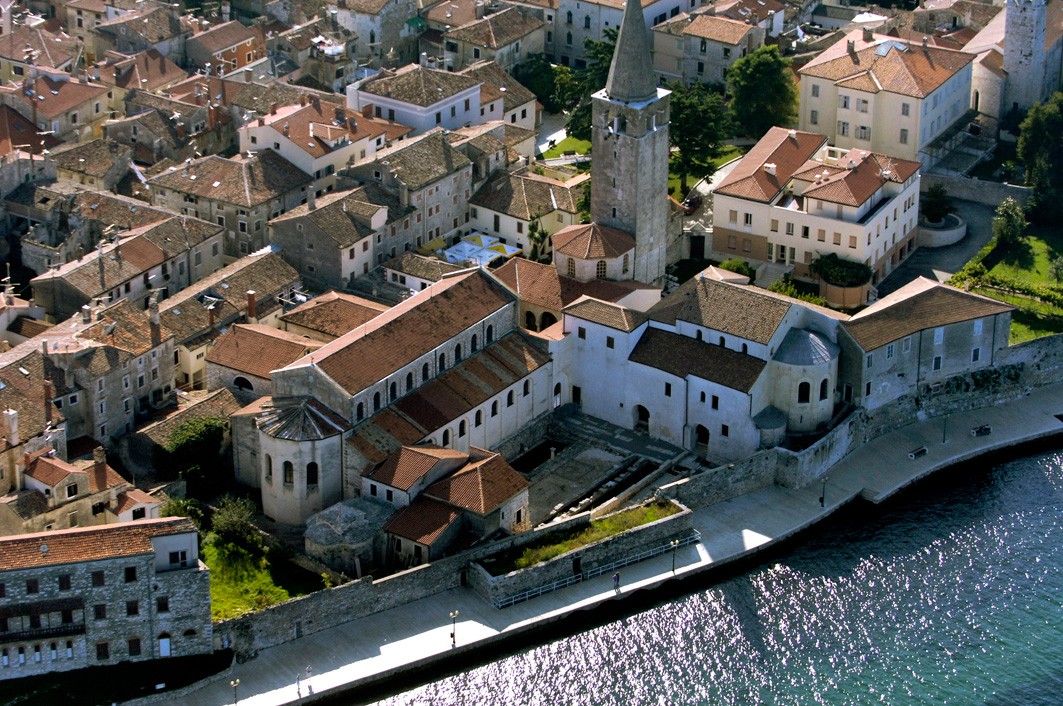
Poreč is a working resort town, and in August the seafront is busy in a way Grožnjan never is. The reason to come is four hundred metres inland: the Euphrasian Basilica, built from around 553 AD, whose sixth-century gold-ground mosaics are among the finest surviving Byzantine work on the Adriatic. UNESCO listed it in 1997. Allow an hour.
The old town around it still runs on its Roman street grid and you can walk the peninsula in half an hour.
How long to allow
Both towns in one day is comfortable, not rushed: roughly ninety minutes in Grožnjan, an hour for the basilica, an hour or two for lunch and the old town in Poreč, plus about an hour and a half of driving in total. Call it six to seven hours from Rovinj.
If you would rather do one properly, the split is easy. Grožnjan is a morning. Poreč is an afternoon and an evening, and it has the better dinner.
When to go
Grožnjan is at its best in late spring and September — the galleries are open, the music school is running or just finished, and you are not sharing the lanes. In midsummer it is hot and exposed on the hilltop by midday, so go early.
Poreč in July and August is genuinely crowded and the basilica has a queue. May, June, September and October are better for both towns, and the basilica is more pleasant out of season anyway — the mosaics are lit and there is room to stand and look.
In winter a good number of Grožnjan’s galleries close. It is still a lovely walk, but do not go expecting twenty open doors in January.
The Parenzana, if you cycle
The narrow-gauge railway between Poreč and Trieste opened in 1902 and closed in the 1930s. Its trackbed is now the Parenzana cycling and walking trail, and it runs directly beneath Grožnjan through tunnels and over viaducts on a gentle railway gradient.
It is the best thing in this corner of Istria for anyone on two wheels, and the section around Grožnjan is the most scenic. We can drop bikes and riders at one end and collect them at the other, which saves the out-and-back.
Getting there from Rovinj
Poreč has a reasonable bus service from Rovinj in season. Grožnjan effectively does not — it is inland, above a steep approach road, and there is no service that makes a day trip work.
By car it is about forty minutes to Poreč and a little over an hour to Grožnjan, where you park below the town and walk up the last stretch.
A private transfer to Grožnjan or a transfer to Poreč removes the parking problem in both towns, and for the two-town version it is the only way to do it without the day becoming about the driving.
Practical notes
- Grožnjan is car-free inside the walls. Park below and walk up a short, steep slope.
- The basilica is an active church. Shoulders and knees covered, and no visits during services.
- Gallery opening in Grožnjan is informal and seasonal. Mornings are the safe bet.
- Poreč old town is pedestrianised; the nearest parking is a walk from the basilica in summer.
- Both towns are stone-paved and uneven. Flat shoes.
Travel time from Rovinj: about 40 minutes to Poreč, about 1 hour 15 to Grožnjan.
Plan your transfer
Pula and Bale Day Trip from Rovinj
Pula and Bale are twenty minutes apart and could not be less alike. One is a working city of 50,000 people built around a Roman amphitheatre that has been standing for two thousand years. The other is a stone village on a low hill that most people drive straight past on the way south, and which has perhaps three streets worth the name.
Taken together they make the most rewarding day out from Rovinj, and the reason is the contrast. Pula shows you what Istria was when Rome ran it. Bale shows you what the interior still looks like when nobody has built a hotel.
Pula, and how much of it to do
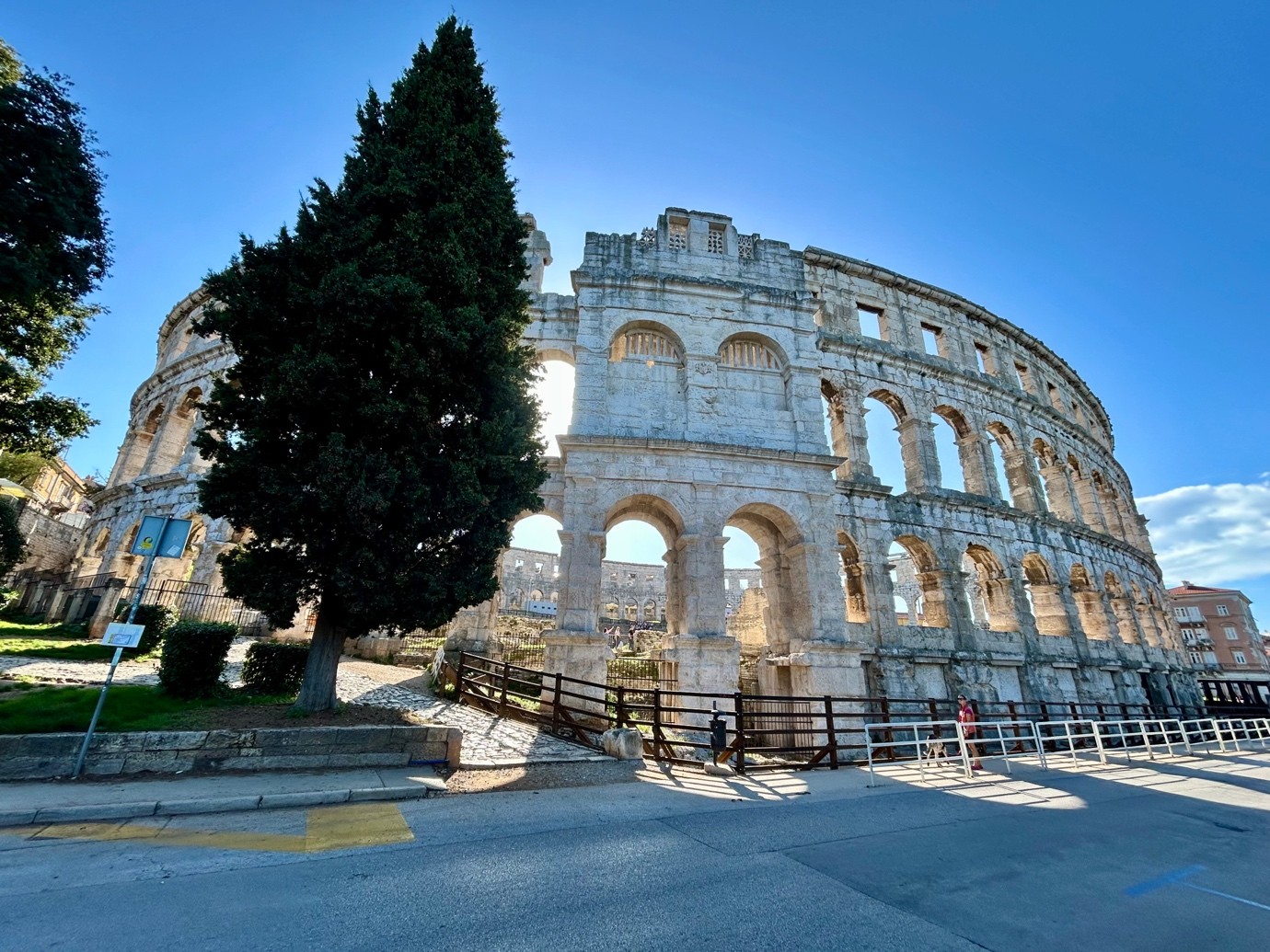
The Arena takes about an hour. It is the sixth largest Roman amphitheatre still standing and the only one that has kept its complete outer wall and all four side towers, and the underground passages hold an exhibition on Roman oil and wine. Allow another two hours for the Roman centre — the Forum, the Temple of Augustus, the Arch of the Sergii — which almost nobody does, which is why it stays pleasant even in August.
Bale, the town most people drive past
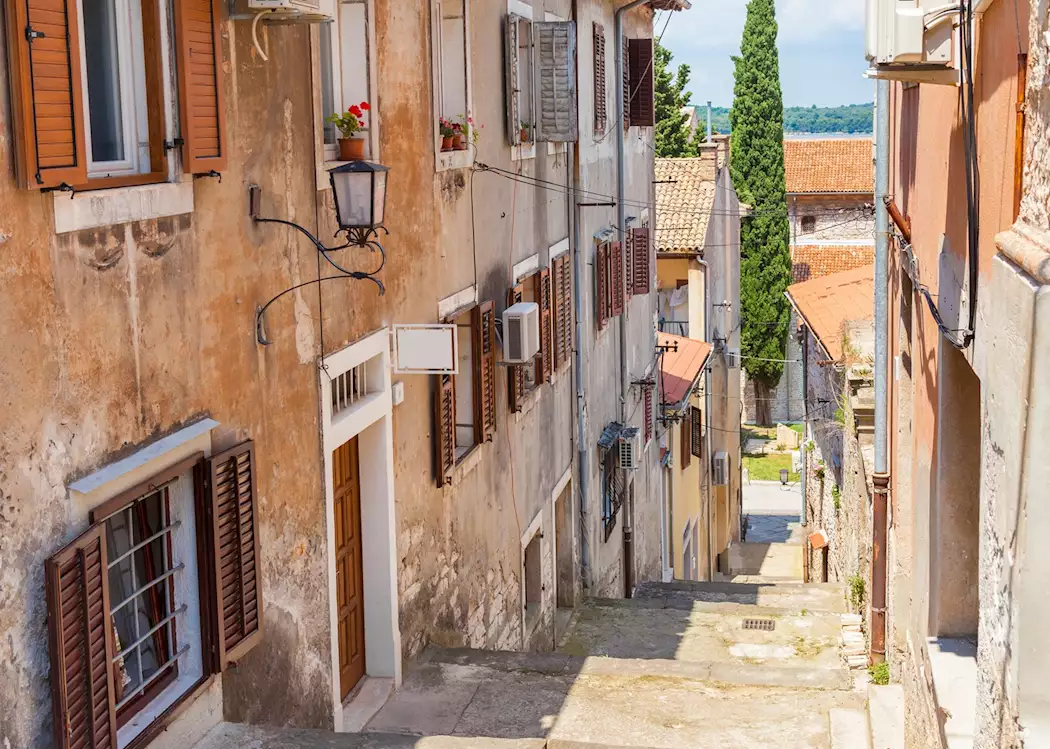
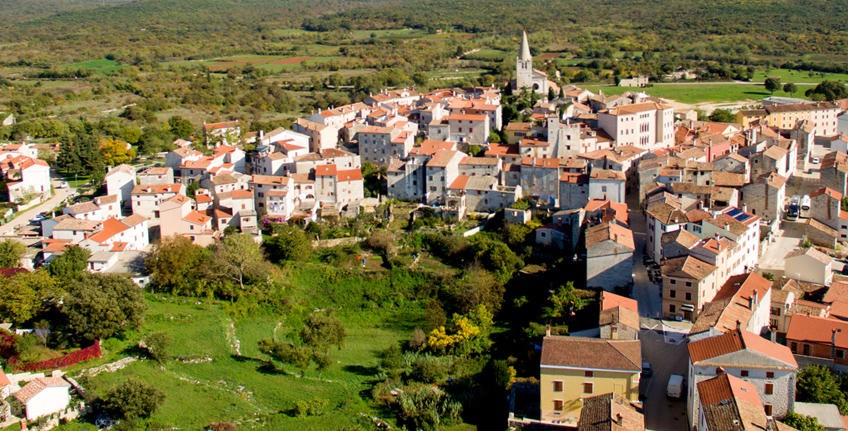
Bale — Valle in Italian, and both names are official — sits on a low hill directly on the road, roughly halfway between Rovinj and Pula. No seafront, no marina, no large hotel, and that is the point. The old core is stone houses on alleys built for donkeys, and the largest building is the Soardo-Bembo castle, formed by filling the gap between two medieval towers with a Gothic-Renaissance palace.
The oddest thing in Bale is the dinosaurs. A diver found bones in the limestone on the seabed off the coast in 1985 and again in 1992 — the first dinosaur bone site found in the Mediterranean — and a species described from the material was named Histriasaurus boscarollii after Istria and its finder. The finds are displayed in town. If you are travelling with children, lead with this and the rest of the day becomes much easier.
How long to allow
A half day does Pula badly. You will see the Arena, photograph it, and leave without seeing the Forum, which is the part people remember.
The honest answer is a full day: leave Rovinj around nine, stop in Bale for an hour on the way down, reach Pula before eleven, do the Arena and then the old town, eat late, and come back in the afternoon. That is roughly seven hours door to door and it is not a rushed day.
If you only have half a day, skip Bale, go straight to Pula and give it four hours. Bale deserves better than twenty minutes and it will still be there next week.
When to go
July and August are hot and the Arena has almost no shade — the stone holds the heat and there is nowhere to sit out of the sun inside it. If you are going in high summer, be at the Arena when it opens or go in the last two hours of the day, and do the old town and Zerostrasse in the middle.
May, June and September are the good months. October is quieter still and perfectly pleasant, though some smaller places in Bale close for the season.
Cruise ships call at Pula through the summer, and when one is in, the Arena and the main street fill up for a few hours in the middle of the day. It is worth checking before you set out.
Getting there from Rovinj
There are buses between Rovinj and Pula and they are inexpensive, but the timetable thins out sharply outside July and August, the last service back is early, and Bale is effectively unreachable by bus as a day trip.
Driving is straightforward — it is forty kilometres and around forty minutes — but Pula’s centre is largely pedestrianised and parking near the Arena in summer takes time you would rather spend elsewhere.
The third option is a private transfer from Rovinj to Pula, which we run daily and quote at a fixed price per vehicle. The practical advantage for this particular trip is the Bale stop: we can wait while you walk the old town, then carry on south, which no bus route allows.
Practical notes
- The Arena has very little shade and the steps are uneven Roman stone. Flat shoes, and water.
- Zerostrasse stays cool year-round — take a layer if you feel the cold.
- Bale’s old town is stone-paved and gently steep. It is manageable with a pushchair but not comfortable.
- Smaller places in both towns still prefer cash, though cards are widely accepted in Pula.
- Opening hours for the Arena, the crypt and the Histriasaurus exhibition change by season. Check on the day rather than trusting a printed guide.
Travel time from Rovinj: about 20 minutes to Bale, 35–45 minutes to Pula.
Plan your transfer
Bled and Ljubljana from Rovinj: A Full-Day Excursion
Slovenia’s two best-known places sit close enough together to see both in a single day from Istria — and close enough to Rovinj that the driving is manageable. Lake Bled is about two and a half hours away; Ljubljana is on the road home. Since Croatia joined the Schengen area and adopted the euro on 1 January 2023, the whole excursion runs on one currency with no queue at the frontier. This is a long day, roughly twelve to thirteen hours door to door, but it is a comfortable one.
Lake Bled
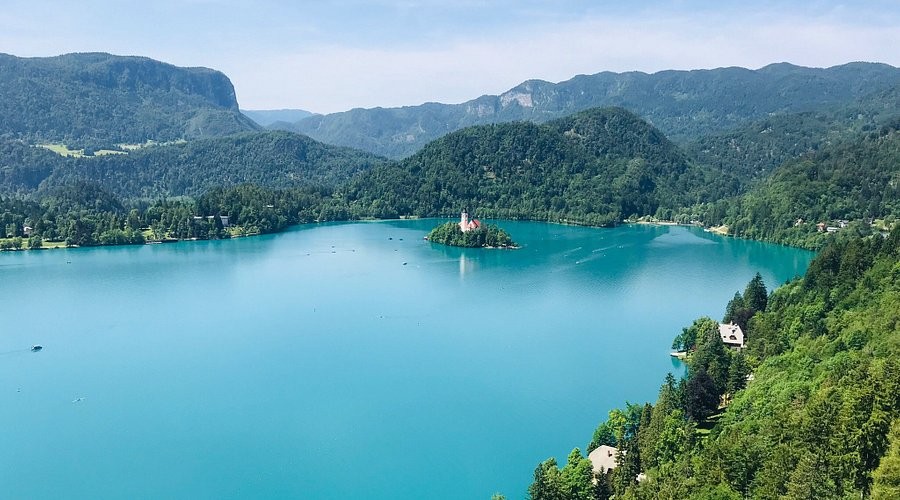
The lake is small — just over two kilometres long and 29.5 metres at its deepest — which is part of why it photographs the way it does: the castle on its cliff, the island in the middle and the Julian Alps behind all fit into one frame. Bled Island is the only natural island in Slovenia.
The island, the 99 steps and the wishing bell
You reach the island by pletna, a flat-bottomed wooden boat with a striped awning, rowed standing up by a boatman working two oars. The families of the village of Mlino have held the hereditary right to row to the island since Empress Maria Theresa granted it in the eighteenth century, and the boats still carry around eighteen to twenty passengers. The return crossing costs €20 per adult and €10 for children aged 4 to 12; boats leave from four docks — Kazina, Mlino, Vila Bled and Velika Zaka — when they have enough passengers.
From the landing, a Baroque stairway of 99 steps, built in 1655, climbs to the Church of the Mother of God on the Lake. A church has stood here since the eighth century; the Baroque interior dates from the mid-1600s and the bell tower is 52 metres high. Inside hangs the wishing bell. The legend, as the island itself tells it, concerns a young widow at the castle who had a bell cast in her husband’s memory; the boat carrying it sank in a storm, she entered a convent in Rome, and after her death the Pope sent a replacement bell to the island. Visitors ring it and make a wish. Slovenian grooms still carry their brides up all ninety-nine steps.
Island entry is €12 for adults and €5 for children up to 15, which covers the church, the bell tower lookout and the museum in the Provost’s House.
Bled Castle
The castle stands 130 metres above the lake on a cliff, and it is the oldest castle in Slovenia recorded in writing — first mentioned on 22 May 1011, in a deed of donation from Emperor Henry II to the Bishops of Brixen. It is open every day of the year, 08:00 to 20:00 from April to October and 08:00 to 18:00 from November to March. Adult admission was €19 for the 2026 season. The view from the terrace is the reason to go up: the island, the lake and the Karavanke behind it.
Kremšnita
The Bled cream cake was invented in 1953 by Ištvan Lukačević, head of the patisserie at the Hotel Park. The original is made to a fixed specification — a 7 × 7 × 7 cm cube, two thirds vanilla custard and one third whipped cream, between two layers of flaky pastry — and it is still made to that recipe at the Park café above the lake. Something like fifteen million slices have been sold since. It is not a tourist gimmick; it is the reason half the Slovenes on the terrace are there.
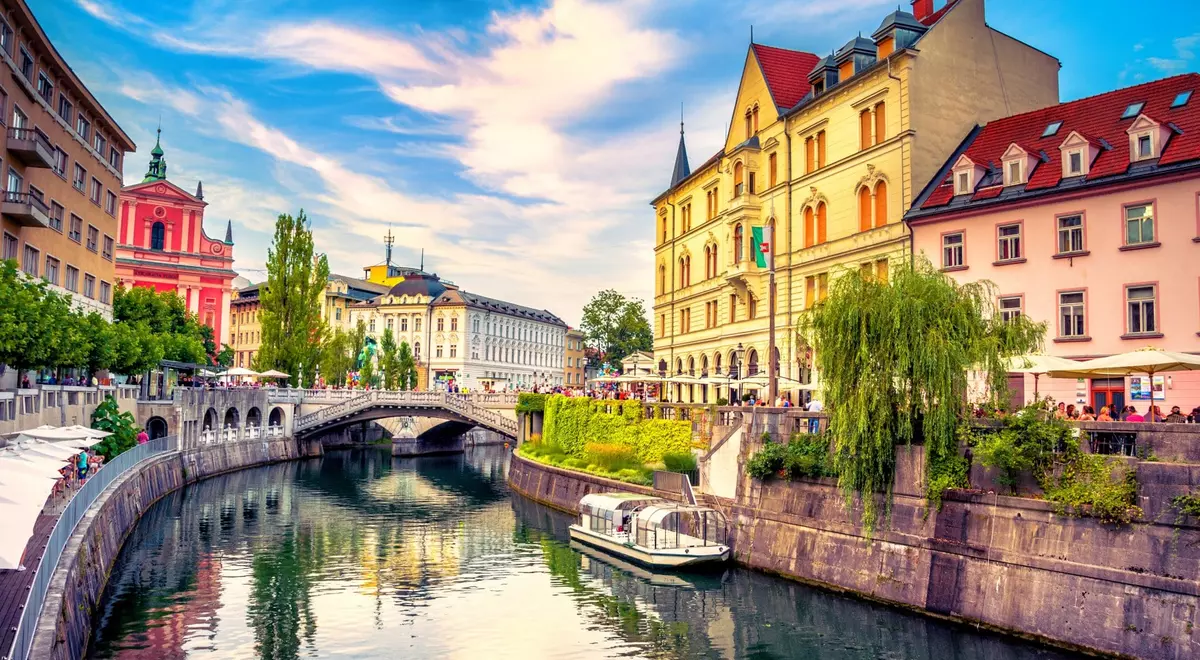
Ljubljana
Slovenia’s capital has around 300,000 people and one of the largest pedestrian zones in the European Union — the historic centre has been closed to cars since September 2007. That matters practically: a vehicle cannot drive into the old town, so the drop-off is at the edge of the pedestrian zone and the city is walked from there. It is small enough that this is an advantage rather than an inconvenience.
What to see in an afternoon:
- Prešeren Square and the Triple Bridge. The central stone bridge dates from 1842; Jože Plečnik added the two angled side footbridges in 1929 and they opened in April 1932. The square is closed on one side by the pink Baroque Franciscan Church and the 1905 monument to the national poet France Prešeren. Plečnik’s work in Ljubljana has been a UNESCO World Heritage Site since August 2021.
- The Central Market. Plečnik’s riverside colonnade, designed between 1931 and 1939 and built along the Ljubljanica between the Triple Bridge and the Dragon Bridge. Also UNESCO-listed.
- The Dragon Bridge, opened on 4 October 1901, with four dragons on its corner pedestals. The dragon is the city’s emblem.
- Ljubljana Castle. The funicular from Krek Square, next to the market, opened in 2006 and takes sixty seconds to cover its seventy metres. A return ride is €6; a full castle ticket including the funicular is €19. In summer the funicular runs until 22:00.
- The Ljubljanica embankments, which are where the city actually spends its evenings.
The drive, the border and the vignette
Rovinj to Bled is about 231 km and two and a half hours. Bled to Ljubljana is 50 km, under an hour. Ljubljana back to Rovinj is about 180 km and just over two hours. Total driving is around five and a half hours, which leaves six to seven hours on the ground in a thirteen-hour day.
Two things catch self-drivers out on this route. First, Slovenia requires an electronic vignette for its motorways — it is linked to the number plate, there is no windscreen sticker any more, and the shortest option for a car is a weekly one at €16 (€32 for a taller vehicle such as a van or minibus). Driving a Slovenian motorway without one carries a €300 fine. Croatia, by contrast, has no vignette and charges tolls by distance at barriers. Second, everyone still needs to carry a passport or national ID card. Schengen means you drive straight through the old crossing points without stopping, but random inland checks do happen.
On a private transfer the vignette, the tolls and the route are the driver’s problem, not yours.
A realistic full-day timetable
- 07:00 — depart Rovinj
- 09:30 — arrive Bled
- 09:30–13:30 — castle, pletna to the island and the 99 steps, a walk along the shore, kremšnita
- 13:45 — depart for Ljubljana
- 14:30–18:00 — Ljubljana: funicular and castle, Triple Bridge, Prešeren Square, the market, the Dragon Bridge, an early dinner by the river
- 18:15 — depart
- 20:30 — back in Rovinj
Bled first, Ljubljana second, for two reasons: the long leg is driven while everyone is fresh, and Ljubljana is genuinely better in the late afternoon and evening, when the funicular and the castle are still open and the riverside fills up.
One seasonal caveat — in winter the island closes at 16:00 and the castle at 18:00, so the Bled half of the day has to be tighter and the Ljubljana stop shorter. Departure and timings are set to suit you when you book.
Plan your transfer
Plitvice Lakes from Rovinj: A Full-Day Excursion
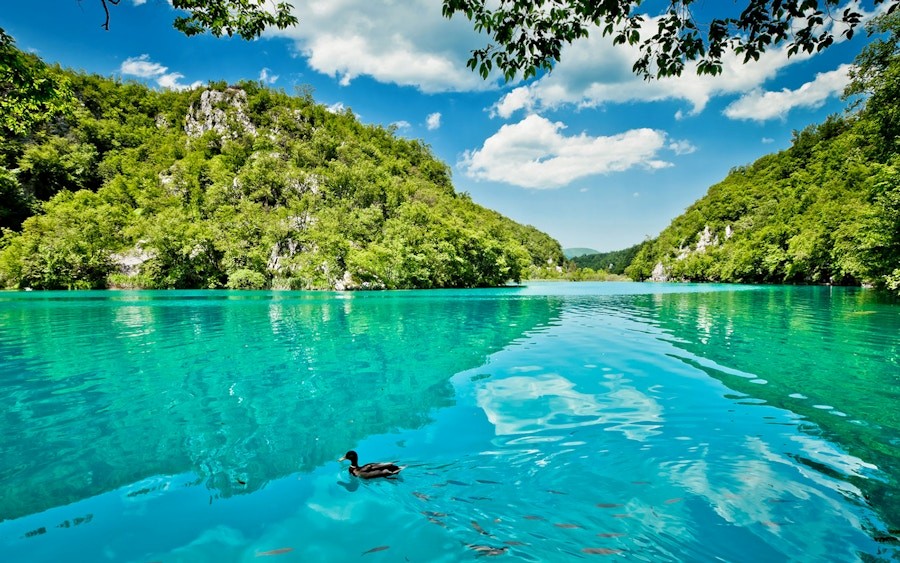
Plitvice Lakes is the one place in inland Croatia that justifies seven hours in a car. Sixteen named lakes fall one into the next down a wooded limestone canyon, joined by waterfalls and crossed by kilometres of wooden boardwalk laid just above the water. It has been a UNESCO World Heritage Site since 1979 and Croatia’s first and largest national park since 1949. From Rovinj it is a full-day excursion in the proper sense: an early start, roughly three and a half hours of driving each way, and four to six hours on the trails in between.
Why Plitvice is worth the drive
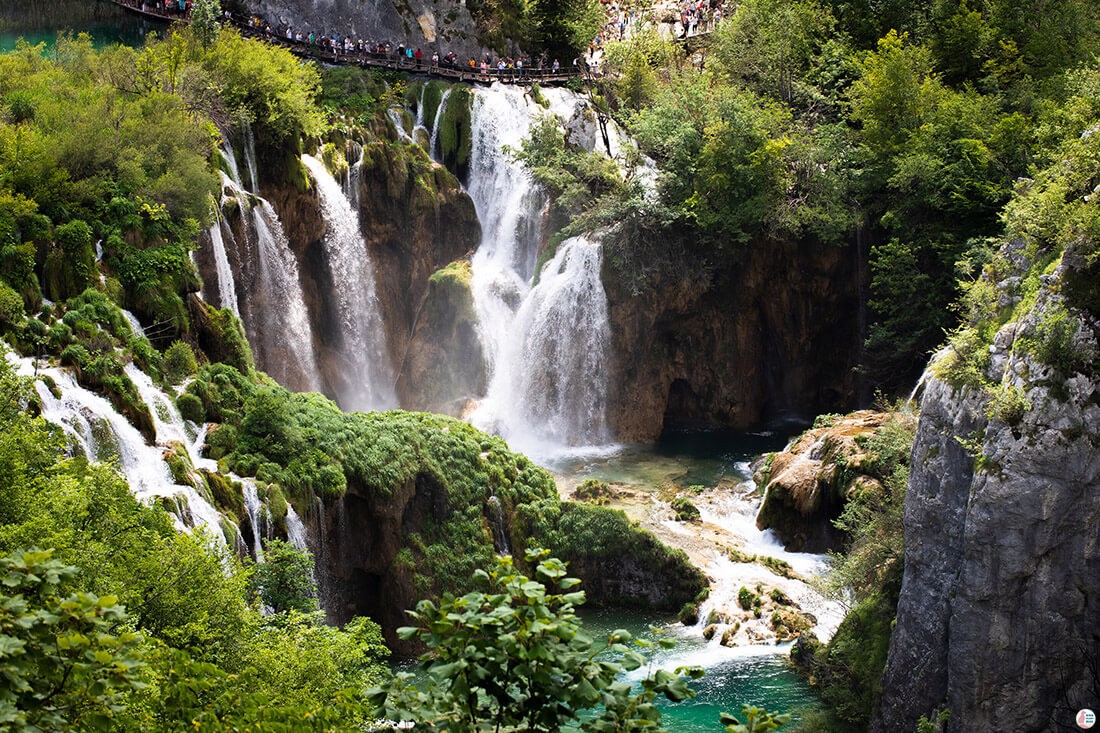
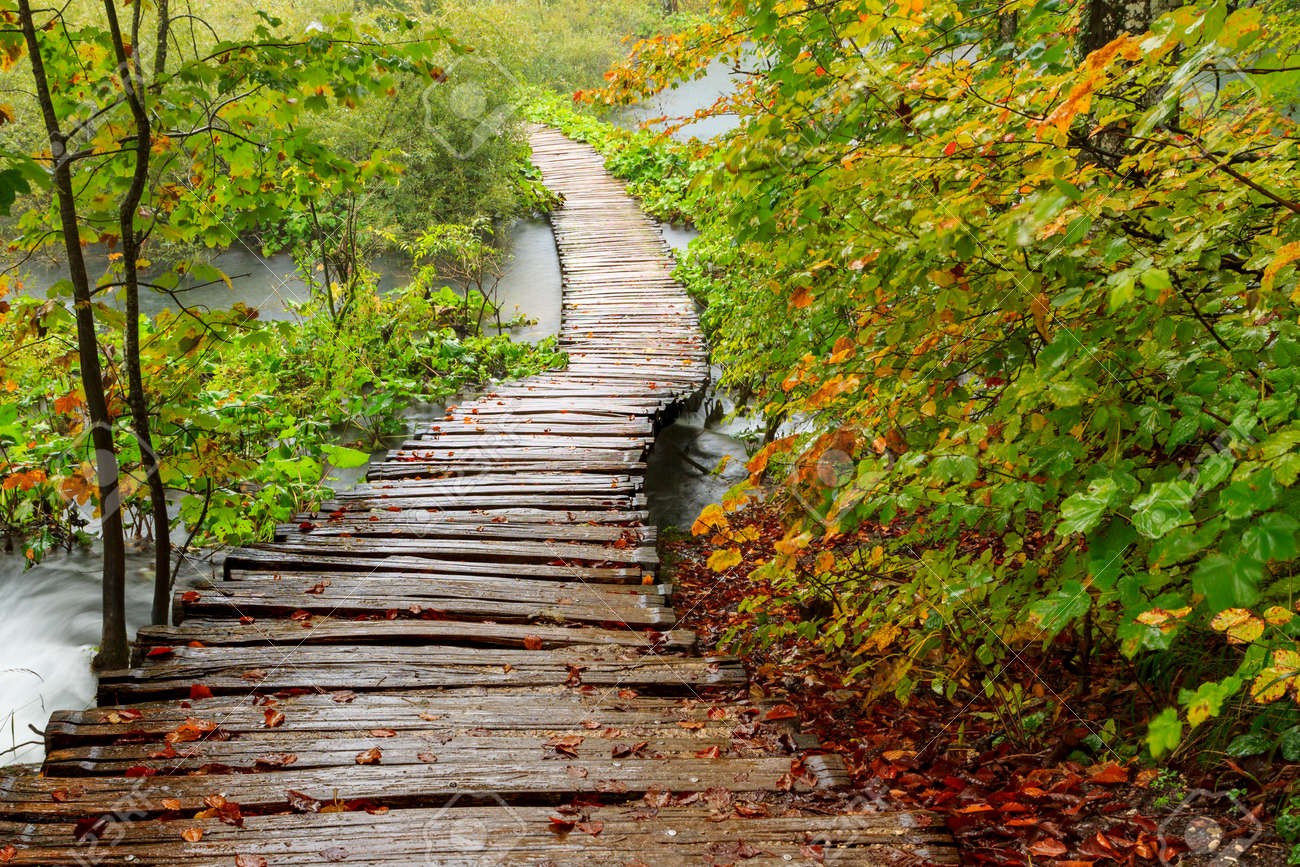
Most visitors come for the colour of the water. What UNESCO actually listed is the process behind it. The barriers that separate one lake from the next are not rock formations in the ordinary sense — they are travertine, or tufa, built up over thousands of years by mosses, algae and bacteria depositing calcium carbonate out of the water. The dams are alive and still growing, which is why every path is a raised boardwalk and why nothing in the park may be touched.
The system runs twelve Upper Lakes and four Lower Lakes, dropping 133 metres from the first to the last. At the bottom of the Lower Lakes canyon the Plitvica stream comes over the edge in a single 78-metre fall — Veliki slap, the tallest waterfall in Croatia. The lakes themselves make up just under one per cent of a park that covers close to 300 square kilometres; the rest is beech and fir forest, and it is genuinely quiet as soon as you leave the main circuits.
What you actually see in one day
The park has two entrances, about three kilometres apart. Entrance 1 (Rastovača), at the northern end, opens straight onto the Lower Lakes and Veliki slap. Entrance 2 (Hladovina), to the south, serves the Upper Lakes and the boat pier on Lake Kozjak.
Walking routes are lettered, and each one is tied to a specific entrance. For a single full day there are two that cover the whole lake system:
- Programme C — from Entrance 1, about 8 km, 4 to 5 hours. Lower Lakes and Veliki slap first, then the boat across Kozjak and up through the Upper Lakes to the Prštavci falls.
- Programme H — from Entrance 2, about 8.9 km, 4 to 6 hours. The same ground approached from the south, with walking, boat and panoramic vehicle combined.
Shorter options exist — A and B from Entrance 1 take two to four hours — and the K1 and K2 circuits run 16 to 17 km over six to eight hours, which is more than a day trip from Istria will comfortably allow. The electric boat across Lake Kozjak and the panoramic train between the shuttle stations are included in the entrance ticket; you do not pay for them separately.
The drive from Rovinj
It is roughly 250 kilometres and three to three and a half hours each way in normal conditions. The route leaves Rovinj on the A9, picks up the A8 at the Kanfanar interchange, crosses under the mountain through the Učka tunnel, joins the A7 past Rijeka and then the A6 toward Zagreb, and turns south onto the A1 at the Bosiljevo 2 interchange before dropping onto the park roads.
Croatia has no vignette — motorway tolls are charged by distance at barriers, and the Učka tunnel is billed separately on top. In a private transfer all of that, along with the fuel and the parking, is inside the agreed price, and nobody has to drive home tired at the end of a long day on foot.
A realistic full-day timetable
- 06:30 — depart Rovinj
- 10:00 — arrive at the park, entrance and ticket formalities
- 10:15–15:30 — the lakes on foot, with the boat and panoramic train
- 15:30 — late lunch near the entrance
- 16:30 — depart for Istria
- 20:00 — back in Rovinj
That is a thirteen-and-a-half hour day. It works because the driving is done for you and the departure time is yours to set — tell us what time you want to be walking and we work backwards from that.
Tickets, crowds and the best time to go
Tickets are tied to a date, an entrance and a time slot. You may arrive up to an hour after your slot but you cannot go in before it, and summer slots do sell out — book online in advance rather than turning up and hoping.
For the 2026 season the park charges adults €40 in June, July, August and September, €23 in April, May and October, and €10 from November to March. There is a reduced late-entry ticket of €25 for arrivals after 16:00 in June–August and after 15:00 in September. Children under seven go free. Check the park’s own price list before you travel, as these are revised each year.
The park caps entries at around 500 visitors per entrance per hour and 12,000 per day, and it welcomed close to 1.5 million people in 2024. July and August are the busiest by a wide margin. If your dates are flexible, late April, May or October give you cooler walking, fuller waterfalls after rain, and a ticket at little more than half the summer price.
Park rules worth knowing before you arrive
- No swimming anywhere in the park — this is strictly enforced.
- Stay on the marked boardwalks and paths. The travertine barriers are fragile and still forming.
- No drones or remotely controlled aircraft.
- Dogs are welcome but must be leashed, including on the boats.
- No cycling inside the park. Cycling is permitted on the state roads and in the neighbouring municipalities, not on the lake trails.
- No fires, no fishing, no picking plants, no feeding the animals.
Wear proper shoes. The boardwalks are wet in places and there is no handrail on much of the route.
Worth adding to the day: Rastoke
About half an hour north of the park, where the Slunjčica meets the Korana at Slunj, the village of Rastoke has waterfalls of the same travertine kind running between and underneath old watermills — at its peak there were twenty-two of them. It has been under heritage protection since the 1960s and is sometimes called the little Plitvice. It sits on the D1 rather than the motorway, so it adds roughly twenty minutes to the return leg. If you would like it included, say so when you book and the driver will plan the route that way.
Plan your transfer